

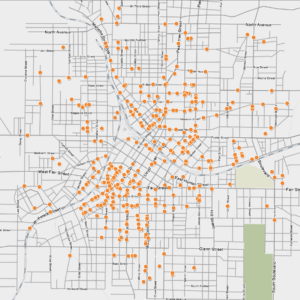
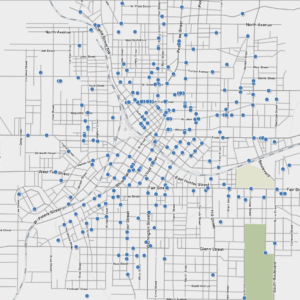
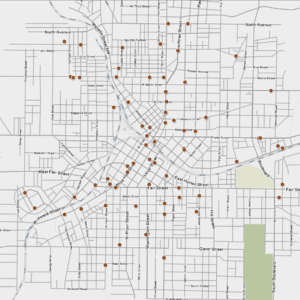
448 male / 269 female
42 children (age 15 and younger)
More of Atlanta’s immigrant population hailed from the German Empire than anywhere else. Included with them here are migrants who were likely to have brought German linguistic or cultural practices from other countries in Central Europe. Their different national origins may have distinguished them from one another, but the local prevalence of German communal life swept Austrian, Swiss, and Hungarian immigrants into its orbit as well.
Chalk it up to Vereinswesen, or “club culture.” German immigrants were especially enthusiastic founders of music and literary societies, civic and fraternal organizations, and similar institutions of community engagement. The Atlanta Turn Verein, founded as a German cultural and athletic club in the late 1860s, hosted regular performances, dances, and political gatherings throughout the 1890s in Turner Hall, on the corner of Marietta and Forsyth Streets. While many of their events were open to the general public, Turn Verein policy required at least two-thirds of their membership (which was limited to men) to be German-born.10 In 1896, a group of young American-born members of German parentage split off to form their own association called the Germania Turn Verein, announcing that “any citizen of the United States with a good moral character regardless of his original nationality” could join.11 The splinter group soon merged with the Freundschaftbund, a local German fraternal organization founded in the early 1890s.
These German societies were responsible for many of the high-culture musical performances in the city at the turn of the century. But it wasn’t all operatic arias and choral recitals. Frequent minstrel shows at Turner Hall, often performed by Turn Verein members, suggest that Atlanta’s Germans enjoyed rougher entertainments as well.12 Minstrel productions also point to Central European immigrants’ racial standing at this moment of Jim Crow’s historical development. Only months before Atlanta’s 1896 special census, the U.S. Supreme Court had ruled (in Plessy v. Ferguson) that laws mandating racial segregation were constitutional. Though Reconstruction-era German immigrants played an important role in Republican Party efforts to defend the rights of Black southerners, by the end of the century, they were increasingly focused on their own processes of acculturation. Access to the status and privileges accorded to white Americans was crucial to this endeavor, especially in the South.13
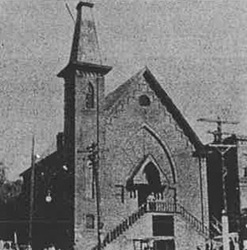
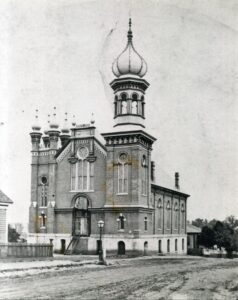
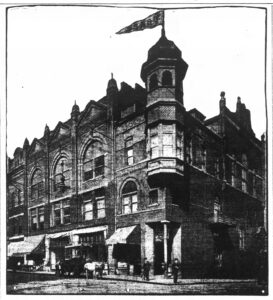
Still, important divisions and differences remained salient within this immigrant group. While most of the city’s Central European immigrants were Lutheran Protestants, migrants from Austria and Switzerland were likely Catholic. Atlanta’s German and Hungarian population also included a sizable Jewish community; according to one historian, more than 200 of the Central European-born immigrants listed in the 1896 census were Jews.14 By the time of the census, this group had founded communal organizations of their own, including the Hebrew Benevolent Congregation, the city’s first institution for Jewish worship. The synagogue they built at the corner of Forsyth and Garnett Streets (see Image #1) stood cattycorner to St. John’s German Lutheran Church (see Image #2). Affiliates of both religious institutions also joined the Concordia Association, a fraternal and recreational club founded by Jews that was open to all who wished to foster German cultural heritage, regardless of religious affiliation. After building a grand downtown hall on Mitchell and Forsyth Streets (see Image #3), the Concordia went into debt and in 1901 passed into receivership.
Central European immigrants’ residential settlement in all parts of the city, their presence in every sector of the economy, and their general inclusion in its civic life suggests that they were an assimilated and accepted group. In fact, Joseph Hirsch, a city alderman and the chairman of the committee overseeing the special census, was a Jewish German immigrant. So what did it mean that German-born Alex Kreisle, as well as his American-born wife and children, were listed in the 1896 census with “Jew” as their land of origin?15 Was there a misunderstanding between the census taker and Kreisle? Did the census taker interpret Kreisle’s Jewishness as foreign, in a literal sense? The Kreisle family’s nativity — listed in the census by their religion rather than their places of birth — is an anomaly, and it remains unexplained.
362 male / 292 female
36 children (age 15 and younger)
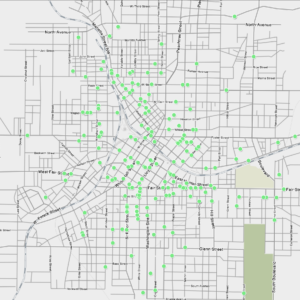
The majority of Atlanta’s white native-born population was of Anglo- and Scots-Irish descent. White Anglo-Saxon Protestant immigrants thus assimilated into the city’s white population quickly and thoroughly. Newcomers from Great Britain (England, Scotland, and Wales) were more evenly residentially dispersed among Atlanta’s six wards than any other immigrant group. They frequently married American-born spouses, and could be found throughout the city’s economy, from wealthy businessmen to petty merchants, from white-collar professionals to manual laborers.16
Atlanta’s migrants from Great Britain made minimal effort to maintain group cohesion or foster the culture of the land of their birth. It is unknown if any immigrants listed in the 1896 census belonged to the local chapter of the Scotch-Irish Society, a national group that celebrated the heritage of “Ulster Presbyterians” in American politics and culture. (Southern members paid additional tribute to their ancestors’ role in the history of the Confederacy.) Newspaper reports about this organization suggest most members were American-born descendants of Scots-Irish immigrants.17 Some may have joined the Robert Burns Club, a literary and cultural society organized that year to honor the eighteenth-century Scottish Enlightenment poet. But that club’s core principles vacillated between Scottish ethnonational identity and inclusionary literary fellowship; though most of the founding members were of Scottish descent (and at least one was born there), three were Jews born in the U.S. to German immigrant parents. For them, Burns represented a humanistic and soulful spirit accessible to all, regardless of ethnic or religious background.18
Irish immigrants more actively fostered ethnic and religious community. They did so under the growing pressure of anti-Catholic nativism throughout the U.S. Though American anti-Catholicism was rooted in the political and theological disputes of the English Reformation, its main target at the end of the nineteenth century was immigration from majority Catholic countries, especially Ireland and Italy. The American Protective Association (APA), an anti-Catholic political organization founded in the Midwest, had by 1896 found traction throughout the South. A year before Atlanta’s special census, a national leader of the APA gave a lecture downtown, warning his audience against electing Catholics to political office. “Suppose we were to have a war and the Pope were to interfere,” he cautioned, invoking the canard that Catholics were loyal to their Church above all else. “What the Pope says is supreme [to them],” he declared, “and they would turn against us if they were ordered to.”19
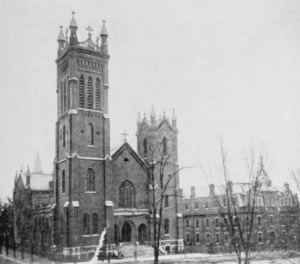
But in general, Irish Americans were comfortably ensconced in the city’s structures of power. Categorized as white in the turn-of-the-century South and heavily aligned with the Democratic party, the APA’s presence in Atlanta burdened them little. They fostered numerous religious and ethnic organizations for Irish Atlantans, both native-born and immigrant. In addition to two Catholic churches — the Shrine of the Immaculate Conception (see Image #4), which still stands today near the Capitol Building; and the Church of Saints Peter and Paul, near where the Georgia Aquarium is today — they had the Hibernian Benevolent Association, the Hibernian Rifles, and the Ancient Order of the Hibernians, all of whom met regularly at Hibernian Hall, on Marietta Street near Five Points. (“Hibernia” is a symbolic personification of Ireland, much like the figure “Columbia” has long been associated with the United States.)
A significant number of Atlantans who hailed from the British Empire came from Canada. Our neighbor to the north also received millions of immigrants during these decades; a cursory glance at last names listed in the 1896 census suggests German, Irish, French, and Dutch ancestry among them. But at least one Canadian came from American immigrant parentage: Hattie Smith, a Black woman whose parents were born in New York and Maryland. By 1861, the year Hattie was born, they were living in Canada. Whether they had escaped slavery or were free people of color who had abandoned an enslaving nation is unknown. In 1896, Hattie was living in a Black section of Atlanta’s Sixth Ward with her South Carolinian husband, two Canadian-born daughters, and two lodgers.20
An additional handful of emigrants in this category were whites who came to Atlanta from areas of the British Empire further afield: Cornelia Park, a teacher born in India to a family of New England Unitarian missionaries; and two women from Australia, one of whom was Jewish. Five more came from the British West Indies, but I have categorized them by their region of origin; more about them below, in the “Caribbean and Latin America” section.
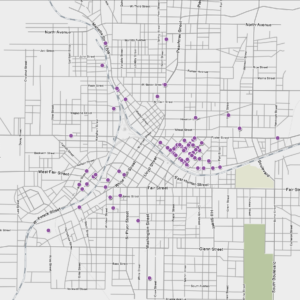
168 male / 147 female
72 children (age 15 and younger)
Atlanta’s 1896 census takers regularly encountered residents who refused to answer their questions. Among those who resisted interrogation were Eastern European Jews, referred to locally as “Russian Jews” regardless of their country of origin. These immigrants seemed “unable to understand the object of the census,” according to the Constitution.21 They had emigrated from places where official censuses were followed by punishingly onerous taxes on Jewish communities and the conscription of all Jewish boys and young men into the Russian army. Having fled from such treatment, some recent Jewish arrivals to Atlanta proved reluctant respondents. But it was illegal (and punishable by a $100 fine) to decline to participate, so census takers occasionally asked policemen to accompany them to Russian Jewish homes and intimidate them into compliance.22
No immigrant group in Atlanta formed as concentrated a residential cluster as did Jewish immigrants from the Pale of Settlement, the region where Jews in Tsarist Russia were forced to live. Eastern European Jews began migrating to the U.S. in significant numbers in the 1880s, escaping antisemitic legislation and violence. By 1896, the city’s Russian Jews outnumbered Jewish Atlantans born in Central Europe. So many lived in tenements in the mixed-race Decatur Street district and along the streets directly north that the neighborhood was sometimes referred to as “the Jewish ghetto.”23 (The word “ghetto” was first used in sixteenth-century Italy, to describe urban areas where Jews were segregated by law.) These immigrants were also distinctive by their gender ratio and the number of children: they emigrated in family units, with offspring in tow, as refugees in search of safe harbor and permanent resettlement.
Relations between Americanized German Jews and Russian newcomers were complicated, and sometimes contentious. Shared religious identity did not mean that they shared worship practices. Russian Jewish immigrants, as a group, adhered to traditional ritual customs (what we would today call Orthodox Judaism), and they found the Hebrew Benevolent Congregation’s assimilated religious rites to be insufficiently devout. So in 1887 they founded Ahavath Achim, the first congregation for Eastern European Jews in Atlanta. By the decade’s end, Ahavath Achim would break ground for a synagogue building of their own, at the corner of Piedmont and Gilmer Streets. At the time of the census, however, they were still worshipping in rented halls along Decatur Street.24
These two Jewish communities found themselves at odds in 1896 over issues of economic status and mutual respect. Many Eastern European Jews arrived in Atlanta without a penny. Local German Jewish women’s benevolent groups had organized assistance for their destitute co-religionists, funding a public bathhouse on Decatur Street for their use and a “Sabbath School” for their children. But a local Jewish newspaper described these charitable efforts in terms that some of the Russians found patronizing and insensitive.25 Leon Eplan, a Decatur Street pawnbroker and one of the first Russian Jews to settle in Atlanta, accused the women’s groups of using his community’s poverty to flatter their own standing.26 He instructed them, to use a modern phrase, to check their privilege. “Be charitable to our needy, if you wish,” he told them, “but do not publish us as barbarians, constantly inviting the contempt of our fellow citizens.”27
Eplan hoped his community would be able to achieve “prosperity and American citizenship in our own humble way.”28 Eventually they would; but at the turn of the century, they were regarded as a strange presence in downtown Atlanta. The local press often employed antisemitic stereotypes in their depictions of Russian Jewish peddlers and shopkeepers on Decatur Street, referring to them as “nervous” aliens and unmanly “peculiar little fellows.”29 In May 1896, when a fire laid waste to an entire block in the Decatur Street district, a reporter described the immigrant Jewish merchants whose shops were in danger as jabbering chaotically in multiple languages simultaneously: “One moment they would speak in Russian to be replied to by an assistant in German. Then both would join in a chorus of Hebrew mingled with a smattering of doubtful English.”30 In fact, they were probably just speaking Yiddish, the native vernacular for Eastern European Jews.
61 male / 56 female
7 children (age 15 and younger)
Millions of Europeans from the continent’s northern and western regions migrated to the United States during the first half of the nineteenth century. In some sections of the U.S., it remained a primary place of origin through the end of the century; the upper Midwest continued to be a magnet for Scandinavian settlement. But the South exerted little pull for them, with only a handful of exceptions. New Orleans, unsurprisingly, was the only southern city that attracted many French emigrants.
Thus, alas, there isn’t much to say about their collective presence in Atlanta. White southerners considered immigrants from this part of the world to be the “best” kind: easily categorizable as white, and Christian in religious worship. The historical record suggests they felt little pressure to create their own institutions or cultural societies. French and Belgian Atlantans could join one of the city’s two Catholic churches, and Scandinavians could attend the German Lutheran church or shift to a different Protestant sect. One might say that as white-Anglo-Saxon-Protestant-adjacent, they easily assimilated into the city’s white population.
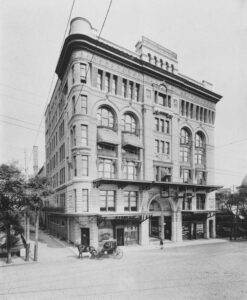
Still, as individuals they left their mark on the city. Few Atlantan emigrants from northern continental Europe left as lasting a mark as Laurent DeGive. Born and raised in Belgium, DeGive was sent to Atlanta by the Belgian government in 1859, to facilitate trade relationships between his native country and southern businesses.31 While he continued to serve as Belgian consul until his death in 1910, he also invested in real estate on his own account. In 1870, he purchased a half-finished building on the corner of Marietta and Forsyth Streets, turning it into the city’s first opera house. By the time of the special census, DeGive had built yet another opulent theatrical space: the Grand Opera House, located where Forsyth Street ends on Peachtree (see Image #5). It was, insisted the Atlanta Journal, a “handsome monument” to both DeGive himself and to “the material growth and prosperity of the city.” After DeGive’s death, the theatre became Loew’s Grand, and in 1939 it hosted the movie premiere of Gone with the Wind.32 The theatre closed in 1977, stood abandoned for another year, and was demolished in 1978 after a fire (which some suspected had been set on purpose) damaged the building.
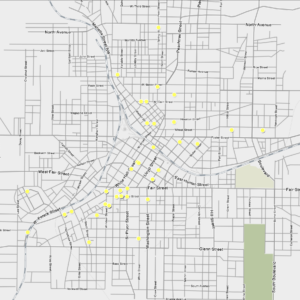
57 male / 47 female
24 children (age 15 and younger)
Nearly all of the immigrants from south of the continental U.S. came from Cuba. Fleeing the violence and economic privation of Cuba’s war for independence from Spain, thousands of refugees sailed to U.S. ports in 1895. By 1896, Atlanta was one of several southern cities hosting a new Cuban population, and the Constitution declared Atlanta to have become a “mecca” for Cubans in exile.33 The newspaper celebrated their presence and their cause, proving as eager to promote Cuba’s war for independence from Catholic rule as were New York City’s Hearst and Pulitzer newspapers.
Most Cuban immigrants arrived in family units. By the end of 1896, they had mainly settled in and south of downtown, with a small cluster in middle-class bungalows along Rawson and Woodward Avenues. Several claimed to have been prosperous in Cuba: “I was considered very wealthy,” one Cuban man reported to the Constitution, but “my property has been confiscated, my estate burned, including a sugar refinery,” and “a reward [is] set upon my head” by Spanish authorities.34 The Constitution reporter noted that like most of his compatriots, this Cuban immigrant had been reduced to making cigars in Atlanta, “for which they easily find sympathizing customers” who “know the money goes toward the relief of Cuba.”35
All but one of the Cuban immigrants were listed in the census as white. Spain had abolished slavery in Cuba only ten years earlier; it is thus possible that some of these Cuban refugees had been enslavers. While some white Cubans defended the valor and military brilliance of Cuba Libre’s Black leaders, others insisted that their movement was in line with southern racial sensibilities, assuring white Atlantans that their cause would not lead to “negro domination.”36 “Cuba is not a country of negroes and half breeds,” grumbled a local Cuban. “That is what the Spanish say” in hopes of undermining American support for the revolt, he insisted.37
Florencio Rabello, the only Afro-Cuban identified by the census, had come to Atlanta as the cook for a wealthy Cuban family. The Constitution might have been referring to him in their short item on “a full-blooded black African negro” who had migrated from Cuba.38 Since he “cannot speak a word of English,” Black Atlantans could not understand him, and “what good is Spanish to a man in conversation on lower Decatur Street?”39 He was, tragically, a man without a community, unable to communicate with other Black people and forbidden from publicly socializing with Spanish-speaking whites. Perhaps, the article facetiously suggested, he should learn Hebrew or German.40
In January 1898 — as the U.S.S. Maine sat in Havana Harbor, only weeks before its fateful destruction — the Constitution happily announced that the Cuban refugees had decided to relocate permanently and settle in their new city.41 But they turned out to have been a peripatetic bunch. By 1900, only a quarter of the city’s Cubans remained; ten years later, the entire war-refugee community was gone from the city, perhaps in search of more sizeable Cuban immigrant communities elsewhere in the United States.
The 1896 census also lists ten other immigrants from the Caribbean and Latin America. Three were designated “C,” or “colored.” Jamaica-born William A. Green and his wife Mary lived on Auburn Avenue, where he served as pastor to St. Paul’s Episcopal Church, the oldest Black Episcopal Church in Georgia.42 The third, a West Indian woman named Atherton, was listed as residing at Spelman Seminary; more will be said about immigrants who studied at Atlanta’s Black colleges further below, in the section on African-born Atlantans in the 1896 census.
Eloise Gaston Gay is the only individual listed in the 1896 census of South American birth. She came from white American parentage: her father, James McFadden Gaston, had served as a surgeon in the Confederate Army. He and his wife fled South Carolina at the end of the Civil War, taking up residence in Brazil, where Eloise was born. Like many of the Confederados who exiled themselves to Brazil (where slavery remained legal until 1888), the Gastons retained their American citizenship. The family eventually returned to the U.S., settling in Atlanta after Reconstruction’s end.43
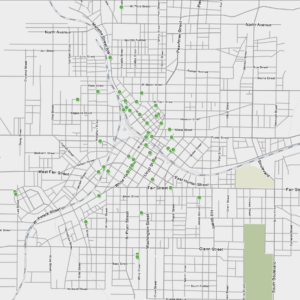
67 male / 28 female
7 children (age 15 and younger)
The locations categorized together here span thousands of miles, from the western edge of the Mediterranean Sea to the eastern periphery of the Ottoman Empire. Immigrants from these places were a mix of Catholics, Eastern Orthodox, Muslims, and Jews. The political systems they came from differed significantly. Some areas in this category, as listed in the 1896 census — “Arabia” and “Scythia,” specifically — are a little mysterious. Since further research on the eight immigrants in question turned up no further information, we can only guess at their actual points of origin.44
The logic for gathering these immigrants in a single category on this map, aside from their geographic origins proximate to the Mediterranean basin, is that they would have shared some comparable experiences in the United States. Alongside migrants from Eastern Europe, they were among the populations of the “Great Wave” of “New Immigration” between 1880 and 1920. Nearly a million Italians came to the United States between 1880-1900, in flight from political instability and lack of economic opportunity. Greeks left Europe for similar reasons, though in smaller numbers, as did subjects of the Ottoman Empire (which included Turkey and Syria, as well as parts of Greece). Syrian Christians were additionally pushed to emigrate by religious persecution under Ottoman Turkish rule.
Atlanta’s Greek and Syrian immigrant communities would each eventually create religious, cultural, and educational institutions of their own, though not until the early twentieth century. In the 1890s, newcomers from the Mediterranean and Levant lived scattered in working-class neighborhoods near the central business district. They sought to establish themselves in the local economy, predominantly through entry-level entrepreneurship and retail commerce. For Italians and Greeks, the most common avenue of entry at the end of the nineteenth century was the fruit stand. Atlanta’s foreign-born “banana men,” as they were known, set up shop downtown, often purchasing their stock of produce cooperatively in bulk. Their low prices put them in direct competition with brick-and-mortar grocers, who regarded them as unwelcome outsiders. Beginning in 1896, the city council began a years-long effort to regulate fruit stands, sometimes invoking “blue laws” that restricted commerce on the Christian sabbath.45 “It is unfair to the Americans who close up their stores on Sunday,” one Atlanta policeman complained of these fruit dealers, “to allow the Italians and Greeks to supply the Sunday demand.”46
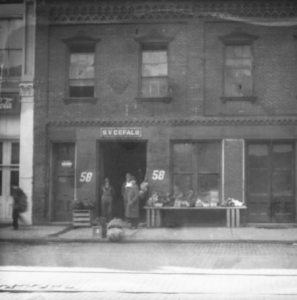
Despite the obstacles native-born grocers tried to set in their way, some fruit stand men eventually upscaled, opening grocery stores of their own. Within a year of the 1896 census, Italians Joseph Cerniglia and Antonio Cefalu had opened a grocery on Whitehall Street; the Cefalu family remained in the local produce business for decades, with wholesale and retail branches downtown in the 1920s (see Image #6).47 Syrians were also engaged in commerce, primarily as peddlers and in dry goods stores. George and Martha Zachen, the only Atlantans listed in the 1896 census as of Syrian origin, ran a general merchandise shop on Decatur Street, where they lived with their American-born daughter. George Daher, an ethnic Syrian from Turkey, was similarly employed.48
Where did Italians, Greeks, and Syrians fit in Jim Crow Atlanta? They were often described as not quite white by both white and Black Atlantans at the turn of the century. All were regularly referred to in the local press as “dagoes,” an insulting ethnoracial slur applied to people from the Mediterranean region. Their religious practices also set them apart from the white mainstream. Surely many were aware that in 1891, 11 Sicilians had been lynched by a white mob in New Orleans. Yet all these immigrants were listed in the 1896 census as white. As much as they surely contended with the dangers of white supremacist culture, they also experienced its privileges: in 1896, for instance, George Daher was naturalized as an American citizen, along with an English immigrant named Alfred Jarvis.49 As we will soon see, access to American citizenship was not available to all of Atlanta’s immigrants.
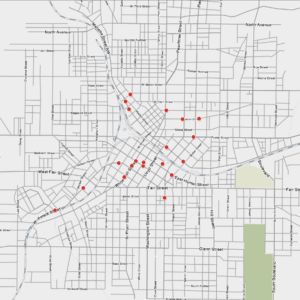
26 male / 0 female
0 children (age 15 and younger)
“No greater curse can well befall [Georgia],” the Constitution had declared in 1880, “than the incoming of a swarm of Mongolians … [T]he south has quite enough of the effects of an inferior race.”50 Anti-Chinese agitation and violence spurred by nativism, racism, and economic anxiety had roiled the states west of the Rockies for decades. White southern politicians joined their western colleagues in demanding restrictive legislation. In 1882, Congress passed the Chinese Exclusion Act, which banned Chinese-born men from becoming naturalized American citizens. It also prohibited the immigration of laborers from mainland China and made it nearly impossible for them to send for their wives and children once they were economically established, which explains the gender imbalance in the census.
By then, a few Chinese immigrants had already ventured south. While some southern whites protested that the introduction of a “third race” would upset Jim Crow’s social hierarchy, others advocated using them to replace Black laborers on cotton and rice plantations.51 According to the 1900 federal census, more than 200 Chinese immigrants were living in Georgia. Most had settled in Augusta, where they’d been hired in the 1870s to widen and deepen the city’s canal. When that project was completed, those who stayed opened small groceries and laundry shops. Atlanta’s Chinese entered the entrepreneurial sector upon arrival, operating twenty-six of the city’s thirty-four brick-and-mortar laundry establishments listed in the city directory.52 They did not cluster in a “Chinatown” of residences, businesses, and communal institutions. Instead, they lived downtown and in surrounding neighborhoods, often bunking in the laundry shops they operated — a frequent practice of Chinese immigrants everywhere in the U.S.53
Though the Constitution had expressed hostility to Chinese immigration in 1880, attitudes got more complicated upon encountering actual Chinese people. The local press portrayed them by turns as industrious entrepreneurs, or as inscrutable heathens; as dignified representatives of an ancient culture, or as a deeply weird curiosity. Russian Jews were often described in similarly ambivalent terms — economically as thrifty but also stingy, culturally as both fascinatingly exotic and perplexingly enigmatic. While both groups were tolerated, they were also objects of mockery, especially when they spoke. The Constitution article on the 1896 Decatur Street fire described the street’s Chinese laundry men as babbling, too, in a jargon that made them seem like “a lot of simians rather than human beings” as they rushed to salvage their businesses, to the delight and amusement of spectators.54
In some ways, Chinese and Russian Jewish immigrants were similarly positioned in southern society. Both were significant and oft-noted presences in Atlanta’s commercial sector. Both belonged to non-Christian religions, which placed them outside of mainstream culture. However, European immigrants were categorized as white. Despite some anti-Jewish bigotry directed their way, Jews from eastern Europe had access to the rights and privileges accorded to white people at the turn of the century. National anti-Chinese legislation, in combination with local prejudices, racialized and marginalized Atlanta’s Chinese community far more severely.
And yet: when census takers ascribed racial categories to Atlanta’s Chinese-born individuals, they were notably inconsistent. Of the twenty-six Chinese men listed in the 1896 census, nine were classified as white. Five were listed as “Chi,” for Chinese, and two more as “C,” though it’s unknown whether this was meant to stand for Chinese or colored. Seven were racially designated “Mong,” for Mongolian; two as “Y,” presumably for yellow; and one was given no racial category at all. This bewildering mess is emblematic of Chinese immigrants’ uncertain and unstable status in Jim Crow Atlanta, where so much was determined by the color line.
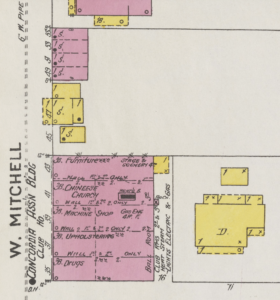
Atlanta’s ambivalence toward its tiny Chinese community could be seen in the 1896 arrest and trial of more than a dozen Chinese men. Police raided a storefront space in the Concordia Building that was alternately referred to as a Chinese freemasons’ “club house” (which conferred upon it social legitimacy), a “joss house” or “Chineese [sic] church” (see Image #7) (which suggested that it was a space of communal religious worship), a “fan tan house” (a reference to a Chinese card game, intimating the presence of illegal gambling), or, most scandalously, an “opium joint.”55 The police report described the scene as a “dope den” littered with barely conscious men “all stretched out and stiff … like corpses.”56 But the trial judge held a more magnanimous opinion of the community: “the Atlanta Chinese, as a class, are good fellows,” the judge told the Constitution; “they never trouble anybody unless someone jumps on them first.”57 Finding the police report and newspaper coverage overly sensationalistic, he dismissed the case with a warning to stay out of trouble.58
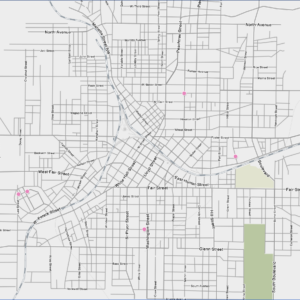
3 male / 3 female
2 children (age 15 and younger)
Atlanta’s special census did not differentiate among specific countries or regions in Africa, nor in South America, for that matter. The federal census similarly categorized African and South American emigrants imprecisely; this was an American failure to recognize heterogeneity and self-determination in the global South, rather than negligence specific to Atlanta’s census takers.
Of the six Atlanta residents born in Africa, two were listed as white. Some of the identifiable white immigrants from both Africa and Latin America were likely born to families of missionaries sent by English and American churches to proselytize to colonial and Indigenous populations. (We have already met one such migrant, born in colonial British India to American missionary parents.) But neither white African-born individual could be found elsewhere in the historical record.
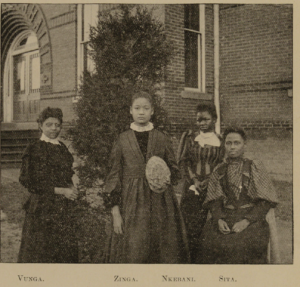
Three of the four African-born Black Atlantans in this census were affiliated with Atlanta’s educational institutions. Samuel Mpemba came from the brutalized Belgian colony known as the Congo Free State; only 13 years old, he was a student at the Atlanta Baptist Seminary, which later became Morehouse College.59 Unfortunately, it’s not clear how he found his way to Atlanta, or when he left. More is known about Spelman College students Emma Youngblood and Margaret Rattray.60 They, too, both came from the Congo Free State, where a few American-born graduates of Spelman’s missionary training program had established Baptist missions. After briefly studying in Scotland and then London, Margaret (whose original name was Nkebani) arrived at Spelman in 1891. Emma (originally Zinga) matriculated two years later, when she was thirteen (see Image #8). Though Rattray returned to Africa by 1900, Youngblood stayed in Atlanta at least a decade more, working as a medical professional at the Leonard Street orphanage for Black girls.61
The sixth, listed as James M. Droane in the census, was the oldest of this group and the only Black Atlantan born in Africa before slavery ended in the United States. His historical trail runs cold beyond that, except for one tantalizing clue: his address is listed as 30 Yonge Street, the residence of Henry McNeal Turner.62 Turner was one of Georgia’s most important Black leaders: a Bishop in the AME Church, chancellor of Atlanta’s Morris Brown College, and an outspoken advocate for Black Americans’ emigration to Africa. In fact, Turner helped organize the migration of 500 Black Americans to Liberia in 1895 and 1896.63 Perhaps Mr. Droane was only briefly in Atlanta as Turner’s houseguest, to assist in these efforts. Deeper research would be needed to know for sure. But even if this hypothesis doesn’t pan out, it still serves to remind us that during this era of mass immigration to the U.S., the flow of people moved in many directions.
