Racial and ethnic minorities in the United States are disproportionately impacted by environmental hazards such as industrial pollution and natural disasters. Studies of environmental justice highlight these inequalities, attributing them to an extensive combination of systemic racism that restricts such communities from escaping or preventing these hazards. This association between environmental issues and minorities in the metropolitan Atlanta area has been the subject of conversations for decades in both local media and academic research, generating debates on poor environmental law enforcement, limited outdoor recreation access, and increased risk exposure to environmental hazards.
The research on environmental justice in metro Atlanta has primarily been limited to predominantly Black communities, as racial dynamics have historically reflected what Dan Immergluck calls a “Black-white dichotomy.” However, within the last two decades, Atlanta has emerged as a major immigrant gateway, transforming into a multiracial landscape with growing clusters of suburban ethnoburbs. With a 30% population increase within the last decade, the Latinx community is one of the fastest growing in metro Atlanta with its members settling along Buford Highway and other suburbs surrounding the urban core. Unique systemic obstacles such as racialized immigration status and policies, language barriers, and the lack of educational opportunities present a novel set of challenges for Latinx residents and immigrants in the face of environmental hazards and pollution. While other vulnerable populations in metro Atlanta are also disproportionately affected by environmental issues, the unique difficulties presented to Latinx communities requires carefully targeted interventions that are sensitive to the cultural and historic contexts of said community.
A prevalent environmental justice concern is the presence of industrial facilities that release toxic chemical byproducts harmful to both humans and the environment. A significant amount of these releases is measured through the U.S. Environmental Protection Agency’s (EPA) Toxics Release Inventory (TRI): a federal program that tracks the quantity of chemicals facilities release into the environment as well as their reduction strategies. This information is published annually in a publicly available dataset. Scholars have previously studied the distribution of TRI facilities in metro Atlanta and its interaction with various socioeconomic factors. The results revealed that census tracts with at least one TRI facility had higher populations of Black and Hispanic people. While this research has begun to establish a relationship between the location of toxic facilities and Latinx populations, a more in-depth analysis reveals additional concerning patterns.
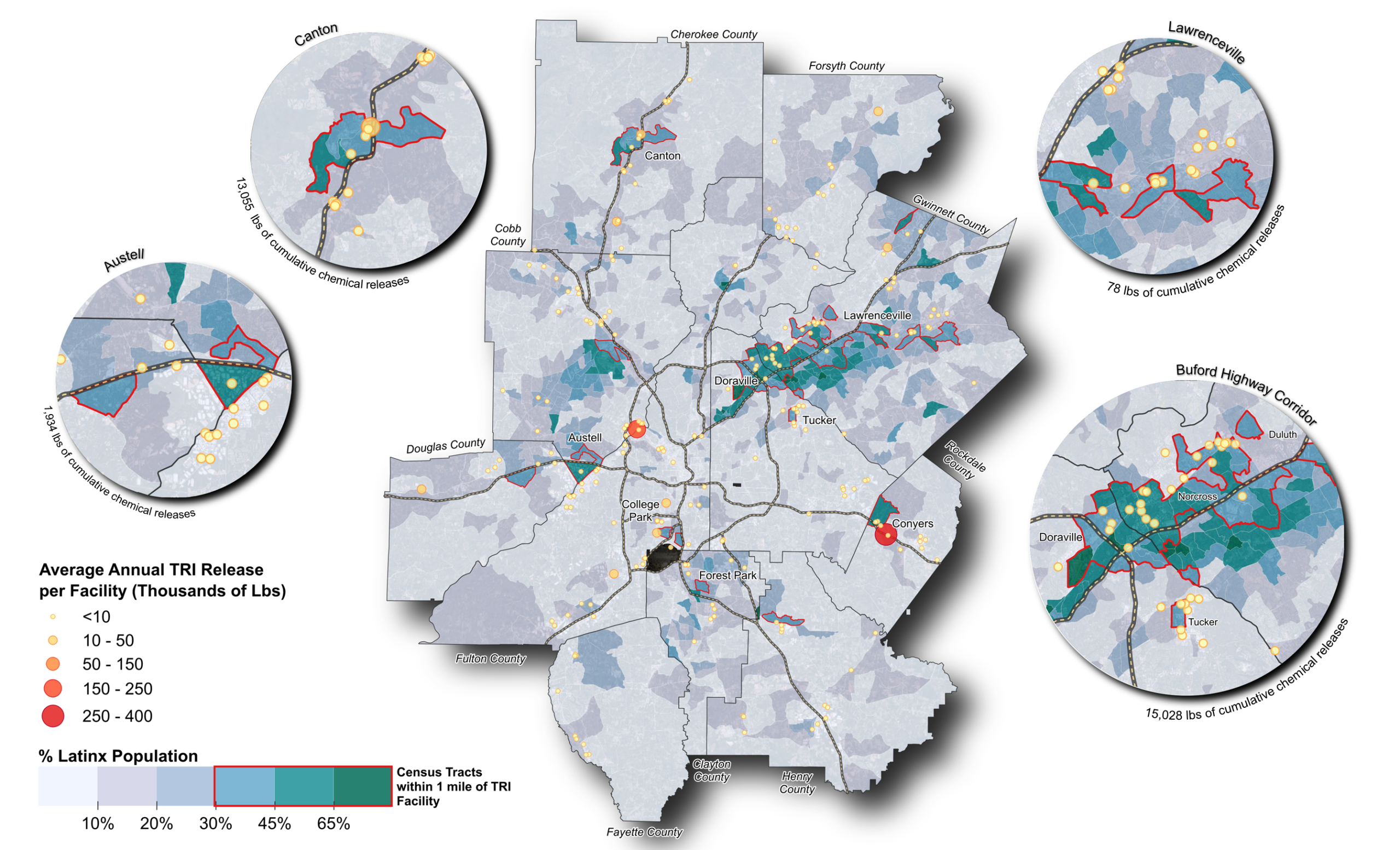
This investigation seeks to explore one facet of the environmental hazards affecting metro Atlanta’s Latinx communities by mapping the distribution of TRI facilities in relation to the region’s Latinx population. In the map below, circular symbols represent individual facilities and their annual TRI release based on the average of on-site chemical releases over the past five years (2020-2024). Larger symbols represent a greater average release of chemicals.
There are a total of fifty-five census tracts (each outlined with a red border) where the Latinx population is greater than 30% and is located within a mile of a toxic release facility. A total of seventy-four toxic release facilities are within one mile of the fifty-five tracts, releasing an average of 46,565 pounds of toxic pollutants each year. From this set of facilities, 58% of the chemicals released are listed as hazardous air pollutants under the Clean Air Act, 27% are categorized as carcinogens, and 22% are categorized as persistent, bioaccumulative, and toxic chemicals (PBT’s), with many of these chemical characteristics overlapping with each other. Fifty-eight individual chemicals are handled across fifteen different industries. Lead and lead compounds accounted for 13% of the total chemical releases in 2024. Meanwhile, two specific facilities in Fulton County — William C. Meredith Co. Inc, a wood treatment plant, and Owens Corning Atlanta Roofing & Asphalt, an asphalt roofing manufacturer — raise increasing concern since they handle Polycyclic aromatic compounds, which are considered hazardous air pollutants, carcinogens, and PBTs. Additionally, these two facilities have violated EPA standards for the past three years, knowingly increasing the potential health risks for nearby residents.
At first glance, the Buford Highway Corridor running from Doraville to Duluth presents the most striking concern due to the concentration of facilities in the area: twenty-six facilities along a fifteen-mile stretch of a highly concentrated set of Latinx (as well as other immigrant) communities. The cumulative chemical releases for these twenty-six facilities add up to 13,823 pounds. Yet, this area presents only one of many similar concerns. In fact, the chemical discharge of Canton almost matches that of the Buford Highway Corridor, with a cumulative total of 13,055 pounds despite only hosting eight facilities within a much smaller area. There are also clusters of toxic release facilities in Lawrenceville, Tucker, and Austell. While the facilities in these areas have comparatively low chemical releases individually, the concentration of multiple facilities is nevertheless concerning due to the compound effects these releases may have on the surrounding communities, potentially outweighing the impact of a single heavily polluting facility.
The U.S. Environmental Protection Agency states that proximity to a TRI facility does not automatically imply negative health risks for neighboring residents due to the variability in toxicity and type of chemical release. However, by mapping these sites, we see exactly where the intersection of Latinx communities and toxic facilities occurs. The cumulative Latinx population of these fifty-five census tracts is over 100,000 people, or about 15% of the total Latinx population in metro Atlanta. In fact, the TRI program only mandates reporting from facilities that meet certain production thresholds, meaning that the sites included in this project do not represent all pollution sources in metro Atlanta. Additionally, Latinx populations in the U.S. are often underrepresented due to the absence of undocumented immigrants in census counts. These data limitations mean that the environmental justice implications for Latinx communities may be even more serious than the official data suggests. This article, therefore, is an urgent call for awareness and action on industrial pollution and its potential health impacts.
The former director of the Environmental Justice Resource Center at Clark Atlanta University, Dr. Robert Bullard, has stressed the importance of acting on environmental justice concerns preventatively. We cannot wait for lives to be harmed in order to prove health threats. The clustering of toxic industrial facilities in predominantly Latinx communities calls for residents and policy makers to organize against the potential health harms. Increasing awareness and research into one of Atlanta’s fastest growing communities is imperative for the future.